There’s something hypnotic about a glowing sphere spinning slowly in the air. Mechanical LED ball screens aren’t just displays—they’re moving sculptures, little planets of light that draw you in. Unlike flat walls or static panels, these balls rotate, pulse, and sometimes even wobble just enough to feel alive. People stop, look, and can’t help but follow the motion.
In clubs, festivals, shopping malls, or corporate lobbies, a mechanical LED ball is more than decoration. Its shape alone commands attention. You don’t need flashy graphics—the rotation, the curvature, the shimmer of LEDs—it’s already engaging. And when it’s synced with music or interactive content, the effect is almost mesmerizing. The sphere becomes part of the experience rather than just a screen.
Kinetic Tech Meets Light
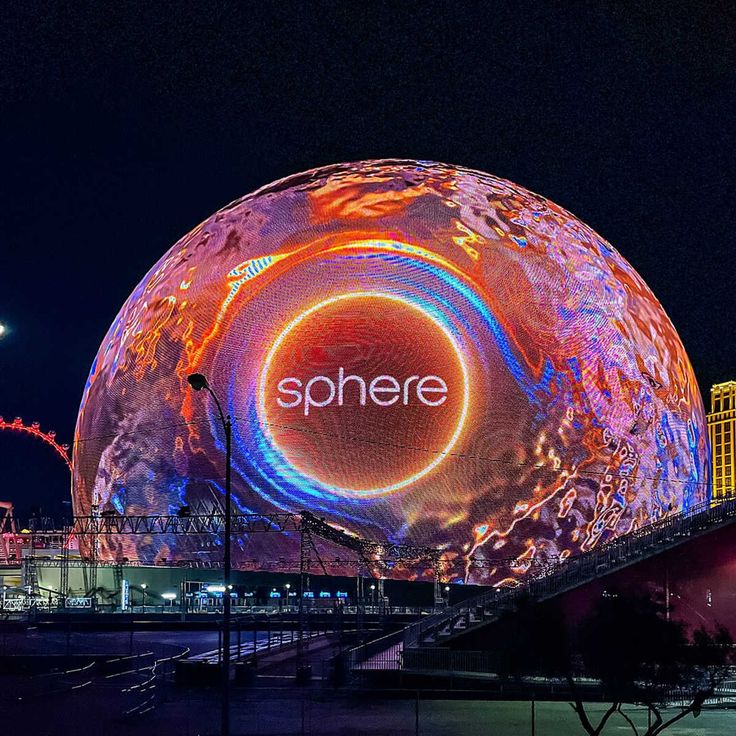
Most displays sit flat on a wall. Mechanical LED balls turn that idea upside down—literally. The sphere rotates on a motorized axis, and the LEDs wrap around the curved surface. Mapping video to a sphere isn’t trivial. Distortion, brightness uniformity, pixel density—all of it matters. But when it’s done right, it looks effortless. Animations spiral around the orb, text flows like ribbons, even simple visuals gain a sculptural feel.
It’s not just about novelty. A spinning LED ball feels different because the brain interprets depth and motion differently on a curve. A circle of color here, a flashing line there—it all feels dynamic in a way a flat panel never could.
Festivals and Clubs
In a festival tent or above a dance floor, the impact is immediate. A spinning LED ball draws eyes without even trying. People unconsciously follow its rotation. When synced to music, every bass drop sends a ripple across its surface. Sweeping melodies can make visuals spiral around the sphere, tiny high-hats trigger flickers of light. The audience isn’t just hearing music—they’re seeing it move through space.
Multiple spheres? Suddenly you’ve got a constellation, a miniature galaxy above the crowd. They can float, hang from rigs, or even glide along tracks. Motion and light combine to make the performance feel alive. You’re not just at a show—you’re inside it.
Engineering Challenges
They look simple, but these things are complex. The frame has to spin smoothly without wobbling, motors need to last through repeated rotations, and the LEDs must stay calibrated while moving. Cabling and power lines all have to survive motion without creating noise or flicker.
Durability is key. These screens get moved a lot—touring DJs, festivals, club nights. One loose motor or flickering pixel can ruin the effect instantly. And yet, when it all works, the sphere feels weightless, like it’s floating in space.
Designing for a Sphere
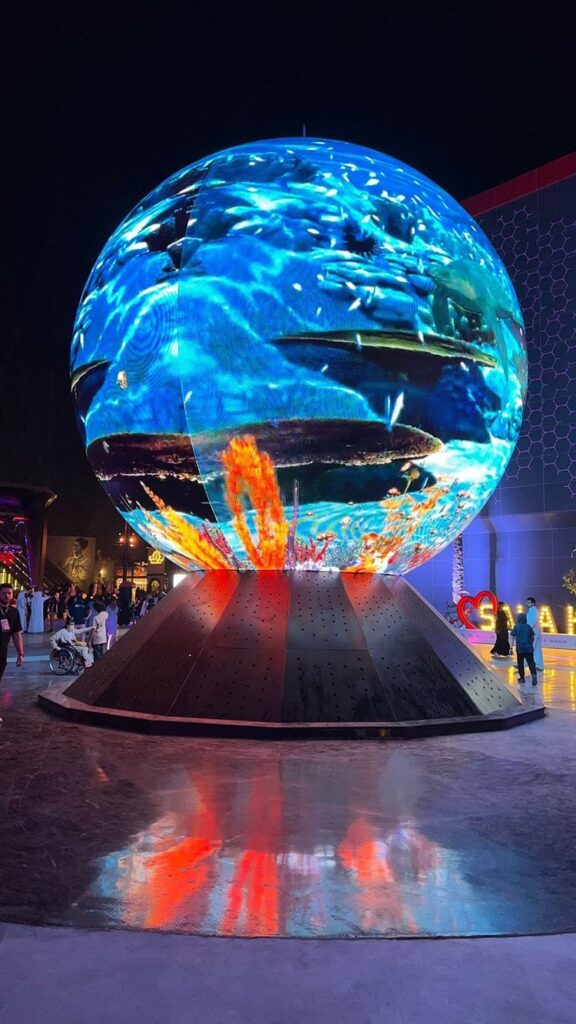
Creating content for a mechanical LED ball is a different skill set. You can’t just throw a flat video on it. Animations have to account for curvature, rotation, and viewing angles. Text has to be readable from all directions. Creative teams start thinking in 3D, not 2D. Spirals, ribbons, and rotating patterns are staples because they play so well with the shape.
Interactive content makes it even more compelling. Motion sensors or audio triggers can make the sphere respond to the audience, giving it a life of its own. People can walk around it, lean closer, even feel like the ball is reacting to them.
Why the Sphere Works
Humans respond instinctively to spheres. Maybe it’s primal—we notice round things in space differently. Mechanical LED balls take advantage of that. The curve, the rotation, the light—it tricks the brain into perceiving motion and depth, even when the content is simple. Reflections and glimmers of LEDs amplify the effect.
This is why they’re used in commercial spaces too. Retailers, hotels, and entertainment venues use them to anchor spaces, highlight products, or create a focal point. A glowing orb is more than a screen—it’s a landmark, memorable in a way flat displays rarely are.
Music and Performance
Where mechanical LED balls shine is in sync with music. DJs and performers can match rotation, color, and animation to the beat. A bass drop might flash across the surface, a melody might spiral around the sphere, and percussive hits can ripple light outward. The audience doesn’t just hear rhythm—they see it move.
Multiple spheres can create choreographed visuals, floating or sliding above crowds. It’s not lighting. It’s a live, kinetic extension of the performance.
Flexibility and Customization
These spheres come in all sizes and resolutions. Small ones are perfect for clubs, larger ones dominate festival stages. Pixel pitch, brightness, rotation speed—they all get tuned for the space. And content? Almost anything can wrap the orb: text, abstract visuals, branding, live feeds. Designers get to play with both shape and content at the same time, which is rare for display technology.
It’s about impact. One sphere can feel intimate, several together can create an entire atmosphere, and the audience gets to experience it all in three dimensions.
Maintenance Realities
Touring, festivals, and club nights aren’t gentle. Motors, LEDs, and controllers have to handle vibration, repeated motion, and transport. Dust, temperature changes, even humidity can cause trouble. Mechanical LED balls aren’t as forgiving as wall-mounted panels, but their reward is big: memorable, kinetic visuals that make people stop and stare.
Maintenance is mostly preventative: keeping motors quiet and smooth, calibrating LEDs, and checking rotation before each show. Even a small wobble or flicker breaks the illusion.
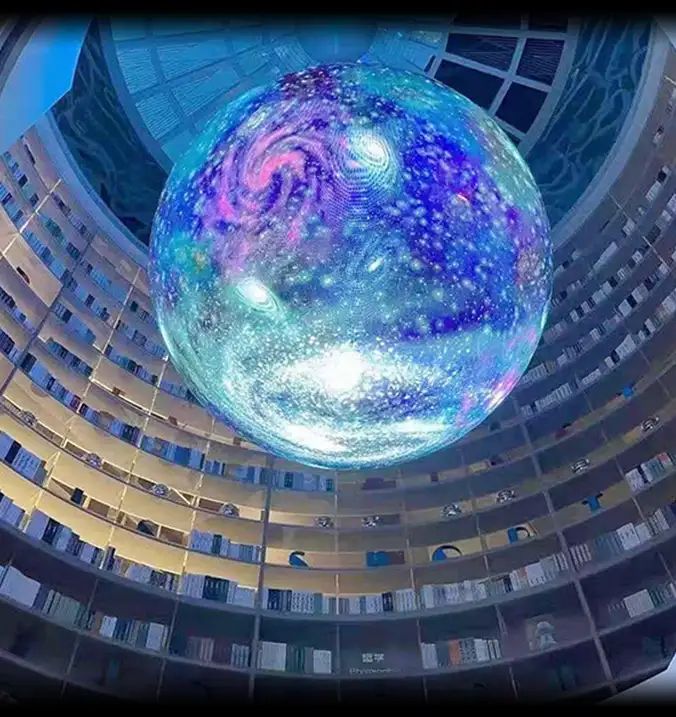
The Experience of a Sphere
At the end of the day, mechanical LED balls are about presence. They pull attention, hold it, and change the way people move in a space. They translate music, motion, and energy into something you can see. Shadows, highlights, pulses of color—they’re all part of the experience.
The sphere isn’t just a display. It’s part performer, part sculpture, part canvas. In clubs, festivals, retail, or corporate spaces, these spheres add movement and depth that flat screens just can’t match. They combine technology with art, motion with perception, and spectacle with subtlety.
Mechanical LED ball screens have changed how audiences interact with light and media. DJ booths, festival stages, shopping centers—they all benefit from the floating, rotating, glowing orb. The sphere spins, it glows, it moves—but more than that, it transforms a space. And in a world full of flat displays, a moving LED orb still manages to feel like magic.