In LED video walls, the most common advice floating around production groups, church tech forums, and Facebook threads is simple: “Buy your second LED wall first.”
The idea is clear—don’t start cheap, because you’ll end up replacing it sooner than you think. But is that always true? And more importantly, does paying triple for a “premium” tile actually produce triple the performance?
Today’s market complicates the old wisdom. The range between “budget” and “premium” has never been wider. You can buy three entire LED walls for the price of one high-end broadcast panel. Meanwhile, new manufacturers are offering mid-tier options with specs that look impressive on paper but include hidden trade-offs in power supplies, EMI shielding, calibration quality, refresh rate stability, and long-term support.
This article breaks down the real, technical differences between budget panels and pro-grade systems—then explains why SeeThruDisplays.com sits in the industry’s true “value-performance” sweet spot: not overpriced like ROE or AOTO, not bargain-bin like low-cost rental lights, but the calibrated, engineered middle that gives buyers the second-wall performance at first-wall pricing.
Budget Panels vs. Premium Panels: What’s Actually Different?
Many churches, event venues, and production teams start their LED journey with budget-friendly panels—usually 2.5mm rental frames, SMD2121 diodes, basic cooling, ribbon-cable-heavy internal wiring, and Novastar A5/A8 receiver cards. These panels deliver a very functional first experience, especially for simple graphics or lyric backgrounds.
But when buyers later demo higher-tier panels from brands like Unilumin, INFiLED, Absen, DVS, or mid-tier integrators, they notice immediate differences:
✔ Smoother gradients
✔ Higher uniformity
✔ Cleaner camera performance
✔ Lower flicker on shuttered imaging
✔ Lower EMI around wireless mics
✔ Better thermal stability
✔ Better cabinet alignment
The question is not whether premium panels are better—they are.
The real question is whether they’re worth 2–4× the price in a permanent install.
This is where SeeThruDisplays’ value proposition becomes clear: you get premium-class components and calibration without absorbing unnecessary “brand tax.”
Pixel Pitch, Cameras, and Why Cheaper Walls Struggle
Most budget 2.5mm panels use:
- SMD2121 black LEDs
- Lower-cost drivers (often 1920–3840Hz)
- Simplified calibration
- Wide variance in LED binning
- Higher scan ratios (1/8, 1/10)
For purely in-room content, these specs perform surprisingly well.
But the moment you introduce cameras—especially global-shutter cinema cameras like RED Komodo—the weaknesses appear:
• Moiré
• Banding
• PWM flicker
• Color stepping
• Mismatched tiles under lighting
• Artifacts at 29.97fps or mixed lighting
High-end panels solve these problems with:
- NationStar 1515/2020 LEDs
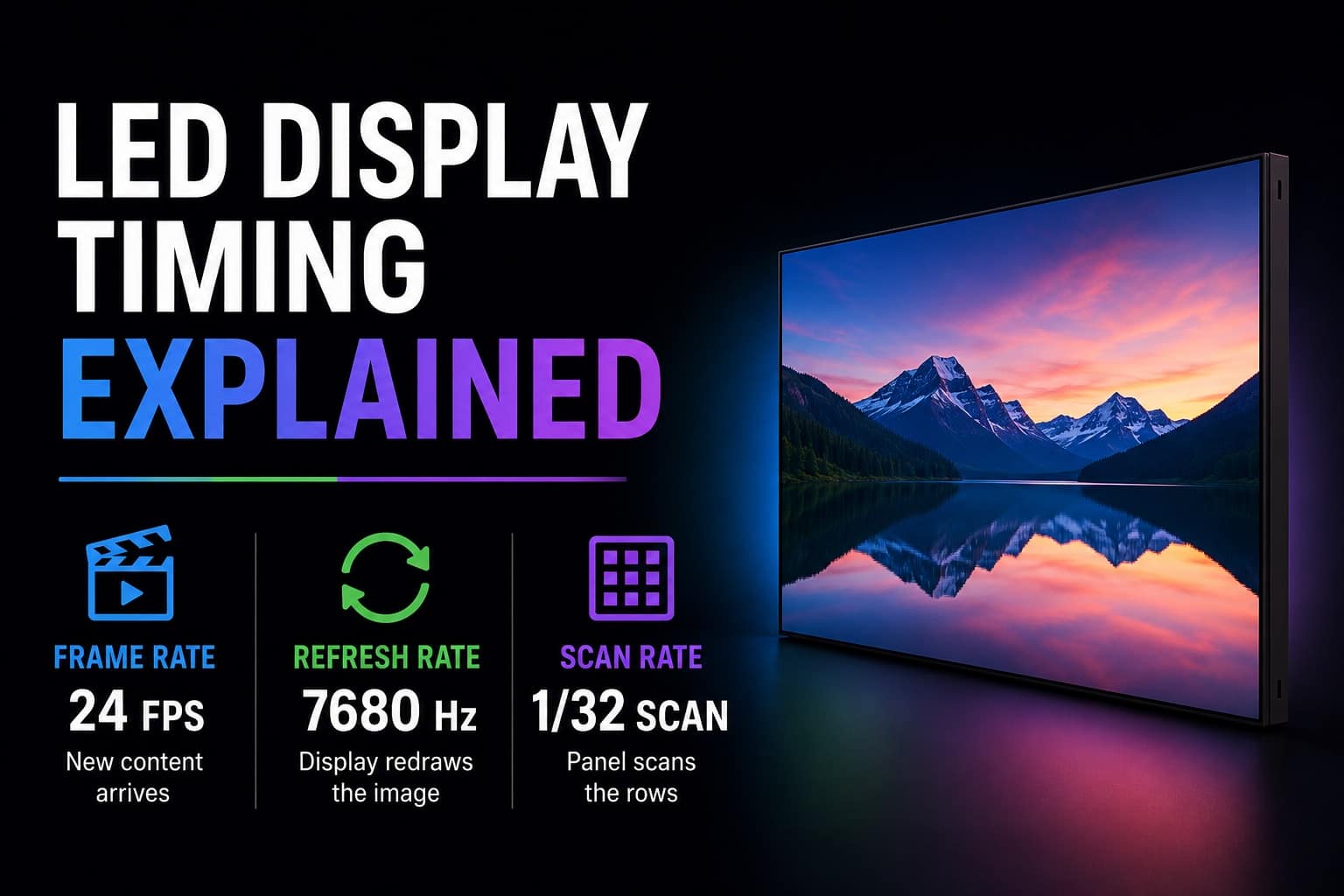
- Macroblock or ICND Pro drivers (up to 7680Hz)
- Tighter binning (color-match across production batches)
- Lower scan ratios for smoother output
- HDR-capable grayscale
- More rigid cabinets for flat surfaces
Budget panels sometimes look great.
Premium panels look great consistently—especially on camera.
SeeThruDisplays’ engineering approach:
Deliver the high-end driver ICs, tight binning, and advanced calibration of premium tiles at a mid-market price, so you don’t need to sacrifice on-camera performance just to save on the initial bill.
Inside the Cabinet: Where Budget Panels Cut Costs
Budget panels reveal their limitations the moment you open the rear cover:
❌ Ribbon cables everywhere
❌ Cable management that varies panel-to-panel
❌ Cheaper power supplies with tiny cooling fans
❌ Limited EMI shielding
❌ Noisy thermal management
❌ Multi-point module alignment drift
❌ No modular quick-swap system
This is why buyers experience:
- Power supply fan noise
- Occasional rattles
- Ribbon-cable failures
- Per-panel brightness variance
- Color drift over six months
- Interference with wireless systems
In fairness, most problems are minor—and budget-conscious buyers tolerate them.
But long-term reliability and camera-critical applications require a different engineering philosophy.
SeeThruDisplays Solution:
- Clean, organized internal architecture
- Industrial MeanWell power supplies
- Fanless or low-noise thermal design
- Rigid die-cast frames
- Front-service magnetic modules
- EMI filtering that protects wireless mics
- U.S. parts availability for fast replacements
You get pro-level architecture without paying ROE pricing.
FCC Certification, EMI, and Wireless Mics
Here’s a problem that’s rarely discussed openly:
Budget panels often aren’t FCC-certified.
They’re UL-listed for electrical safety, but not radio emissions.
What does that mean practically?
- They might generate RF noise
- They might interfere with wireless audio
- They might affect in-ear monitors
- They might cause intermittent dropouts
In many cases, real-world interference is small.
But when issues do occur, troubleshooting can take weeks—and replacing the entire wall becomes the only viable fix.
SeeThruDisplays only offers FCC-certified systems or systems engineered to meet emissions standards equivalent to FCC Part 15.
This protects you from:
- Stage mic dropouts
- IEM interference
- Wi-Fi degradation
- Mysterious RF spikes on spectrum scans
For any venue with wireless audio, this is not optional—it’s essential.
Warranty, Repairs, and Support
One of the biggest hidden costs in the LED industry is parts and repair logistics.
With many budget-tier vendors:
- Repairs happen overseas
- Shipping takes 6–12 weeks
- Replacement modules don’t match the wall
- Production batches change frequently
- Support is limited to email-only
- Companies vanish after 12–18 months
This is where SeeThruDisplays excels.
All products come with:
- U.S.-based support
- Batch-specific LED bins stored for repair
- Full module remanufacturing in the U.S. when needed
- Fast part replacement
- Clear warranty terms (not vague promises)
- Long-term supplier stability
- Calibration files stored per shipment for future matching
This single factor is why many budget panels appear cheap until they fail—then become very expensive.
Do You Really Need Premium Panels?
Not always.
If your use case is:
- A small side screen
- No cameras
- Limited hours per week
- Minimal lighting
- No wireless system nearby
…a budget panel with decent 2.5mm pitch might be enough.
But the moment you introduce:
✔ IMAG
✔ Broadcast
✔ LED stage design
✔ Cinema cameras
✔ Mixed lighting
✔ Long duty cycles
✔ Permanent installation
✔ Large audience visibility
—budget panels reveal their limits.
SeeThruDisplays exists precisely to serve the buyer who doesn’t want cheap gear, but doesn’t want to overpay for a brand name, either.
You get:
- Premium drivers
- Premium LEDs
- Premium calibration
- Premium uniformity
- Premium parts
- Premium support
At mid-market pricing.
This is “buying your second LED wall first”—but with rational economics.
Why SeeThruDisplays Is the True Best-Bang-for-the-Buck Option
If you compare side-by-side:
| Feature | Budget Panels | High-End Brands (ROE/INFiLED) | SeeThruDisplays |
|---|---|---|---|
| LED Binning | Loose | Tight | Tight |
| EMI / FCC | Often uncertified | Certifed | Certified |
| Drivers | 1920–3840Hz | 7680Hz | 7680Hz |
| Camera Compatibility | Mixed | Excellent | Excellent |
| Support | Overseas | U.S.-based | U.S.-based |
| Price | Low | Very high | Mid |
| Cabinet Tolerance | Wide | Precise | Precise |
| Calibration | Basic | Advanced | Advanced |
| Thermal | Noisy fans | Silent | Silent |
| LED Grade | SMD2121 | 1515/2020 | 1515/2020 or high-end 2121 |
SeeThruDisplays is the only provider offering:
Pro-spec performance
+
Mid-range pricing
+
U.S.-calibration
+
Fast support
+
Strong long-term reliability.
This is what buyers actually want—not the cheapest, not the most expensive, but the smartest investment.
Final Recommendation
If your goal is to install a wall that:
- Looks great in person
- Looks flawless on camera
- Won’t flicker
- Won’t interfere with wireless mics
- Won’t need upgrading in two years
- Has real U.S. support
- Has premium components without premium markup
…then SeeThruDisplays is the clear best-bang-for-the-buck solution.
You’re effectively getting the second LED wall you would eventually upgrade to—on your first purchase—without paying the inflated premium.